All the teachers say that spiritual treasure is something one finds alone. So why are we all here together?’ asked a disciple of a Sufi master.
You are all here together because a forest is always stronger than a lone tree,' Sufi master replied. The forest maintains the humidity in the air, it resists the hurricane, and it helps to make the soil fertile. But what makes a tree strong is its root, and the root of one plant cannot help another plant to grow. Working together towards the same end and allowing each one to grow in his own way, that is the path for those who wish to commune with Allah.
Showing posts with label sufism. Show all posts
Showing posts with label sufism. Show all posts
Wednesday, December 24
Tuesday, December 16
Secret of Peace
All masters are moving towards Heaven and through the Seven Heavens. But first you must cut the tunnel of your ego. When you reach out of that tunnel you will find that there are no more bad desires remaining with you. You will be pure. At that moment you will taste the Sweetness of Lights, the Sweetness of Mercy, the Sweetness of Beauty, the Sweetness of Love, the Sweetness of Knowledge, the Sweetness of Wisdom, the Sweetness of Will Power and the Sweetness of Perfection.
Until then you must be patient and follow. You must not say, "Oh, how long do I have to follow without seeing anything?" No, the tunnel is according to your ego, long or short. May Allah grant you to reach your Heavenly Stations; you will then be happy, absolutely happy.
Source: as quoted from the sohbet(discourse)
by As-Sayyid Muhammad Nazim Adil al-Haqqani
Until then you must be patient and follow. You must not say, "Oh, how long do I have to follow without seeing anything?" No, the tunnel is according to your ego, long or short. May Allah grant you to reach your Heavenly Stations; you will then be happy, absolutely happy.
Source: as quoted from the sohbet(discourse)
by As-Sayyid Muhammad Nazim Adil al-Haqqani
Thursday, July 3
How would your respond to the claim that Sufism is bida?
How I would respond by looking to see how traditional ulama or Islamic scholars have viewed it. For the longest period of Islamic history--from Umayyad times to Abbasid, to Mameluke, to the end of the six-hundred-year Ottoman period--Sufism has been taught and understood as an Islamic discipline, like Qur'anic exegesis (tafsir), hadith, Qur'an recital (tajwid), tenets of faith (ilm al-tawhid) or any other, each of which preserved some particular aspect of the din or religion of Islam. While the details and terminology of these shari'a disciplines were unknown to the first generation of Muslims, when they did come into being, they were not considered bid'a or "reprehensible innovation" by the ulema of shari'a because for them, bid'a did not pertain to means, but rather to ends, or more specifically, those ends that nothing in Islam attested to the validity of.
To illustrate this point, we may note that the Prophet (Allah bless him and give him peace) never in his life prayed in a mosque built of reinforced concrete, with a carpeted floor, glass windows, and so on, yet these are not considered bid'a, because we Muslims have been commanded to come together in mosques to perform the prayer, and large new buildings for this are merely a means to carry out the command.
In the realm of knowledge, books of detailed interpretation of the Qur'an, verse by verse and sura by sura, were not known to the first generation of Islam, nor was the term tafsir current among them, yet because of its benefit in preserving a vital aspect of the revelation, the understanding of the Qur'an, when the tafsir literature came into being, it was acknowledged to serve an end endorsed by the shari'a and was not condemned as bid'a. The same is true of most of the Islamic sciences, such as ilm al-jarh wa tadil or "the science of weighing positive and negative factors for evaluating the reliability of hadith narrators", or ilm al-tawhid, "the science of tenets of Islamic faith", and other disciplines essential to the shari'a. In this connection, Imam Shafi'i (d. 204/820) has said, "Anything which has a support (mustanad) from the shari'a is not bid'a, even if the early Muslims did not do it" (Ahmad al-Ghimari, Tashnif al-adhan, Cairo: Maktaba al-Khanji, n.d., 133).
Similarly ilm al-tasawwuf, "the science of Sufism" came into being to preserve and transmit a particular aspect of the shari'a, that of ikhlas or sincerity. It was recognized that the sunna of the Prophet (Allah bless him and give him peace) was not only words and actions, but also states of being: that a Muslim must not only say certain things and do certain things, but must also be something. The shari'a commands one, for example, in many Qur'anic verses and prophetic hadiths, to fear Allah, to have sincerity toward Him, to be so certain in ones knowledge of Allah that one worships Him as if one sees Him, to love the Prophet (Allah bless him and give him peace) more than any other human being, to show love and respect to all fellow Muslims, to show mercy, and to have many other states of the heart. It likewise forbids us such inward states as envy, malice, pride, arrogance, love of this world, anger for the sake of one's ego, and so on. Al-Hakim al-Tirmidhi relates, for example, with a chain of transmission judged rigorously authenticated (sahih) by Ibn Main, the hadith "Anger spoils faith (iman) as [the bitterness of] aloes sap spoils honey" (Nawadir al-usul. Istanbul 1294/1877. Reprint. Beirut: Dar Sadir, n.d., 6).
If we reflect upon these states, obligatory to attain or to eliminate, we notice that they proceed from dispositions, dispositions not only lacking in the unregenerate human heart, but acquired only with some effort, resulting in a human change so profound that the Qur'an in many verses terms it purification, as when Allah says in surat al-Ala, for example, "He has succeeded who purifies himself" (Qur'an 87:14). Bringing about this change is the aim of the Islamic science of Sufism, and it cannot be termed bid'a, because the shari'a commands us to accomplish the change.
At the practical level, the nature of this science of purifying the heart (like virtually all other traditional Islamic disciplines) requires that the knowledge be taken from those who possess it. This is why historically we find that groups of students gathered around particular sheikhs to learn the discipline of Sufism from. While such tariqas or groups, past and present, have emphasized different ways to realize the attachment of the heart to Allah commanded by the Islamic revelation, some features are found in all of them, such as learning knowledge from a teacher by precept and example, and then methodically increasing ones iman or faith by applying this knowledge through performing obligatory and supererogatory works of worship, among the greatest of latter being dhikr or the remembrance of Allah. There is much in the Qur'an and sunna that attests to the validity of this approach, such as the hadith related by al-Bukhari that:
--which is a way of expressing that such a person has realized the consummate awareness of tawhid or "unity of Allah" demanded by the shari'a, which entails total sincerity to Allah in all one's actions. Because of this hadith, and others, traditional ulama have long acknowledged that ilm or "Sacred Knowledge" is not sufficient in itself, but also entails amal or "applying what one knows"--as well as the resultant hal or "praiseworthy spiritual state" mentioned in the hadith.
It was perceived in all Islamic times that when a scholar joins between these aspects, his words mirror his humility and sincerity, and for that reason enter the hearts of listeners. This is why we find that so many of the Islamic scholars to whom Allah gave tawfiq or success in their work were Sufis. Indeed, to throw away every traditional work of the Islamic sciences authored by those educated by Sufis would be to discard 75 percent or more of the books of Islam. These men included such scholars as the Hanafi Imam Muhammad Amin Ibn Abidin, Sheikh al-Islam Zakaria al-Ansari, Imam Ibn Daqiq al-Eid, Imam al-Izz Ibn Abd al-Salam, Abd al-Ghani al-Nabulsi, Sheikh Ahmad al-Sirhindi, Sheikh Ibrahim al-Bajuri, Imam al-Ghazali, Shah Wali Allah al-Dahlawi, Imam al-Nawawi, the hadith master (hafiz, someone with 100,000 hadiths by memory) Abd al-Adhim al-Mundhiri, the hadith master Murtada al-Zabidi, the hadith master Abd al-Rauf al-Manawi, the hadith master Jalal al-Din al-Suyuti, the hadith master Taqi al-Din al-Subki, Imam al-Rafii, Imam Ibn Hajar al-Haytami, Zayn al-Din al-Mallibari, Ahmad ibn Naqib al-Misri, and many many others.
Imam al-Nawawi's attitude towards Sufism is plain from his work Bustan al-arifin [The grove of the knowers of Allah] on the subject, as well as his references to al-Qushayri's famous Sufi manual al-Risala al-Qushayriyya throughout his own Kitab al-adhkar [Book of the remembrances of Allah], and the fact that fifteen out of seventeen quotations about sincerity (ikhlas) and being true (sidq) in an introductory section of his largest legal work (al-Majmu: sharh al-Muhadhdhab. 20 vols. Cairo n.d. Reprint. Medina: al-Maktaba al-Salafiyya, n.d., 1.1718) are from Sufis who appear by name in al-Sulami's Tabaqat al-Sufiyya [The successive generations of Sufis]. Even Ibn Taymiyya (whose views on Sufism remain strangely unfamiliar even to those for whom he is their "Sheikh of Islam") devoted volumes ten and eleven of his Majmu al-fatawa to Sufism, while his student Ibn Qayyim al-Jawziyya wrote his three-volume Madarij al-salikin as a detailedcommentary on Abdullah al-Ansaris Manazil al-sairin, a guide to the maqamat or "spiritual stations" of the Sufi path. These and many other Muslim scholars knew firsthand the value of Sufism as an ancillary shari'a discipline needed to purify the heart, and this was the reason that the Umma as a whole did not judge Sufism to be a bid'a down through the ages of Islamic civilization, but rather recognized it as the science of ikhlas or sincerity, so urgently needed by every Muslim on "a day when wealth will not avail, nor sons, but only him who brings Allah a sound heart" (Qur'an 26:88).
And Allah alone gives success.
Orignally written by Nuh Ha Mim Keller and posted at http://www.masud.co.uk/ISLAM/nuh/sufism.htm
To illustrate this point, we may note that the Prophet (Allah bless him and give him peace) never in his life prayed in a mosque built of reinforced concrete, with a carpeted floor, glass windows, and so on, yet these are not considered bid'a, because we Muslims have been commanded to come together in mosques to perform the prayer, and large new buildings for this are merely a means to carry out the command.
In the realm of knowledge, books of detailed interpretation of the Qur'an, verse by verse and sura by sura, were not known to the first generation of Islam, nor was the term tafsir current among them, yet because of its benefit in preserving a vital aspect of the revelation, the understanding of the Qur'an, when the tafsir literature came into being, it was acknowledged to serve an end endorsed by the shari'a and was not condemned as bid'a. The same is true of most of the Islamic sciences, such as ilm al-jarh wa tadil or "the science of weighing positive and negative factors for evaluating the reliability of hadith narrators", or ilm al-tawhid, "the science of tenets of Islamic faith", and other disciplines essential to the shari'a. In this connection, Imam Shafi'i (d. 204/820) has said, "Anything which has a support (mustanad) from the shari'a is not bid'a, even if the early Muslims did not do it" (Ahmad al-Ghimari, Tashnif al-adhan, Cairo: Maktaba al-Khanji, n.d., 133).
Similarly ilm al-tasawwuf, "the science of Sufism" came into being to preserve and transmit a particular aspect of the shari'a, that of ikhlas or sincerity. It was recognized that the sunna of the Prophet (Allah bless him and give him peace) was not only words and actions, but also states of being: that a Muslim must not only say certain things and do certain things, but must also be something. The shari'a commands one, for example, in many Qur'anic verses and prophetic hadiths, to fear Allah, to have sincerity toward Him, to be so certain in ones knowledge of Allah that one worships Him as if one sees Him, to love the Prophet (Allah bless him and give him peace) more than any other human being, to show love and respect to all fellow Muslims, to show mercy, and to have many other states of the heart. It likewise forbids us such inward states as envy, malice, pride, arrogance, love of this world, anger for the sake of one's ego, and so on. Al-Hakim al-Tirmidhi relates, for example, with a chain of transmission judged rigorously authenticated (sahih) by Ibn Main, the hadith "Anger spoils faith (iman) as [the bitterness of] aloes sap spoils honey" (Nawadir al-usul. Istanbul 1294/1877. Reprint. Beirut: Dar Sadir, n.d., 6).
If we reflect upon these states, obligatory to attain or to eliminate, we notice that they proceed from dispositions, dispositions not only lacking in the unregenerate human heart, but acquired only with some effort, resulting in a human change so profound that the Qur'an in many verses terms it purification, as when Allah says in surat al-Ala, for example, "He has succeeded who purifies himself" (Qur'an 87:14). Bringing about this change is the aim of the Islamic science of Sufism, and it cannot be termed bid'a, because the shari'a commands us to accomplish the change.
At the practical level, the nature of this science of purifying the heart (like virtually all other traditional Islamic disciplines) requires that the knowledge be taken from those who possess it. This is why historically we find that groups of students gathered around particular sheikhs to learn the discipline of Sufism from. While such tariqas or groups, past and present, have emphasized different ways to realize the attachment of the heart to Allah commanded by the Islamic revelation, some features are found in all of them, such as learning knowledge from a teacher by precept and example, and then methodically increasing ones iman or faith by applying this knowledge through performing obligatory and supererogatory works of worship, among the greatest of latter being dhikr or the remembrance of Allah. There is much in the Qur'an and sunna that attests to the validity of this approach, such as the hadith related by al-Bukhari that:
Allah Most High says: ". . . . My slave approaches Me with nothing more beloved to Me than what I have made obligatory upon him, and My slave keeps drawing nearer to Me with voluntary works until I love him. And when I love him, I am his hearing with which he hears, his sight with which he sees, his hand with which he seizes, and his foot with which he walks. If he asks me, I will surely give to him, and if he seeks refuge in Me, I will surely protect him (Sahih al-Bukhari. 9 vols. Cairo 1313/1895. Reprint (9 vols. in 3). Beirut: Dar al-Jil, n.d., 5.131: 6502)
--which is a way of expressing that such a person has realized the consummate awareness of tawhid or "unity of Allah" demanded by the shari'a, which entails total sincerity to Allah in all one's actions. Because of this hadith, and others, traditional ulama have long acknowledged that ilm or "Sacred Knowledge" is not sufficient in itself, but also entails amal or "applying what one knows"--as well as the resultant hal or "praiseworthy spiritual state" mentioned in the hadith.
It was perceived in all Islamic times that when a scholar joins between these aspects, his words mirror his humility and sincerity, and for that reason enter the hearts of listeners. This is why we find that so many of the Islamic scholars to whom Allah gave tawfiq or success in their work were Sufis. Indeed, to throw away every traditional work of the Islamic sciences authored by those educated by Sufis would be to discard 75 percent or more of the books of Islam. These men included such scholars as the Hanafi Imam Muhammad Amin Ibn Abidin, Sheikh al-Islam Zakaria al-Ansari, Imam Ibn Daqiq al-Eid, Imam al-Izz Ibn Abd al-Salam, Abd al-Ghani al-Nabulsi, Sheikh Ahmad al-Sirhindi, Sheikh Ibrahim al-Bajuri, Imam al-Ghazali, Shah Wali Allah al-Dahlawi, Imam al-Nawawi, the hadith master (hafiz, someone with 100,000 hadiths by memory) Abd al-Adhim al-Mundhiri, the hadith master Murtada al-Zabidi, the hadith master Abd al-Rauf al-Manawi, the hadith master Jalal al-Din al-Suyuti, the hadith master Taqi al-Din al-Subki, Imam al-Rafii, Imam Ibn Hajar al-Haytami, Zayn al-Din al-Mallibari, Ahmad ibn Naqib al-Misri, and many many others.
Imam al-Nawawi's attitude towards Sufism is plain from his work Bustan al-arifin [The grove of the knowers of Allah] on the subject, as well as his references to al-Qushayri's famous Sufi manual al-Risala al-Qushayriyya throughout his own Kitab al-adhkar [Book of the remembrances of Allah], and the fact that fifteen out of seventeen quotations about sincerity (ikhlas) and being true (sidq) in an introductory section of his largest legal work (al-Majmu: sharh al-Muhadhdhab. 20 vols. Cairo n.d. Reprint. Medina: al-Maktaba al-Salafiyya, n.d., 1.1718) are from Sufis who appear by name in al-Sulami's Tabaqat al-Sufiyya [The successive generations of Sufis]. Even Ibn Taymiyya (whose views on Sufism remain strangely unfamiliar even to those for whom he is their "Sheikh of Islam") devoted volumes ten and eleven of his Majmu al-fatawa to Sufism, while his student Ibn Qayyim al-Jawziyya wrote his three-volume Madarij al-salikin as a detailedcommentary on Abdullah al-Ansaris Manazil al-sairin, a guide to the maqamat or "spiritual stations" of the Sufi path. These and many other Muslim scholars knew firsthand the value of Sufism as an ancillary shari'a discipline needed to purify the heart, and this was the reason that the Umma as a whole did not judge Sufism to be a bid'a down through the ages of Islamic civilization, but rather recognized it as the science of ikhlas or sincerity, so urgently needed by every Muslim on "a day when wealth will not avail, nor sons, but only him who brings Allah a sound heart" (Qur'an 26:88).
And Allah alone gives success.
Orignally written by Nuh Ha Mim Keller and posted at http://www.masud.co.uk/ISLAM/nuh/sufism.htm
Monday, June 30
3 Keys to Happiness
Here is just such a simple solution, presented in the form of three keys, that when remembered and practiced, keep us going in the right direction and while we walk the path, they also are the catalysts in bringing happiness.
Key 1 - Keep Your Heart Free From Hatred
When people, events and circumstances go against our wishes, desires or expectations, they create reactions of anger and frustration within us. These reactions are natural and must not be denied or ignored - rather their underlying reason must be seen and overcome - that of our pre-decided ideas and expectations being thwarted.
These emotions occur as a natural progression of painful events and are fine as long as they are felt and released. The problem lies when we cannot let go of the feelings and they tend to seep into our hearts where they fester till treated. If such is the case, these negative feelings tend to influence our way of thought, and necessarily, of action and become an integral part of our outlook towards life itself. Then everything that originates within us carries the subtle flavour of these very negative feelings.
The first secret of happiness says that no matter what emotions we feel temporarily, our hearts must remain free of hate.
Key 2 - Keep Your Mind Free From Worry
We worry when our thoughts travel either to the future, or linger in the past. Worry is a phenomenon which depletes energy and divides attention - leaving us incapable of giving our best to the moment before us.
The only way to give a 100% of yourself to the task at hand is to be totally present in the present moment without thinking of what's gone by or what is still to come - both cases where we have no say or control anyway.
Performing the action totally and to the best of one's ability brings back a positive result based on the law of karma - "As you sow, so shall you reap" - a result which would not be possible had we divided our inner being with worry.
The second secret of happiness is to always perform actions based on careful thought and planning, but without worry.
Key 3 - Give A Lot, Expect A Little
It is crucial for our happiness to come to the realisation early in life that it is our own expectations and pre-conceived ideas and hopes, which when frustrated, cause most of our pain and agony.
Once this understanding has stabilized within us, we begin to live for the moment, and within ourselves instead of seeking outward or external reinforces for our self-esteem or happiness.
It is not enough for us to be passive spectators of our own life, we must also be willing to give and share freely of our best qualities without waiting for a similar return.
It is both wise and practical to remember the advice of numerous spiritual masters that "It is in the giving that we receive." The free giving of your own self without strings attached bring both peace and contentment in the long run.
The third secret of happiness is to give a lot and expect very little.
Key 1 - Keep Your Heart Free From Hatred
When people, events and circumstances go against our wishes, desires or expectations, they create reactions of anger and frustration within us. These reactions are natural and must not be denied or ignored - rather their underlying reason must be seen and overcome - that of our pre-decided ideas and expectations being thwarted.
These emotions occur as a natural progression of painful events and are fine as long as they are felt and released. The problem lies when we cannot let go of the feelings and they tend to seep into our hearts where they fester till treated. If such is the case, these negative feelings tend to influence our way of thought, and necessarily, of action and become an integral part of our outlook towards life itself. Then everything that originates within us carries the subtle flavour of these very negative feelings.
The first secret of happiness says that no matter what emotions we feel temporarily, our hearts must remain free of hate.
Key 2 - Keep Your Mind Free From Worry
We worry when our thoughts travel either to the future, or linger in the past. Worry is a phenomenon which depletes energy and divides attention - leaving us incapable of giving our best to the moment before us.
The only way to give a 100% of yourself to the task at hand is to be totally present in the present moment without thinking of what's gone by or what is still to come - both cases where we have no say or control anyway.
Performing the action totally and to the best of one's ability brings back a positive result based on the law of karma - "As you sow, so shall you reap" - a result which would not be possible had we divided our inner being with worry.
The second secret of happiness is to always perform actions based on careful thought and planning, but without worry.
Key 3 - Give A Lot, Expect A Little
It is crucial for our happiness to come to the realisation early in life that it is our own expectations and pre-conceived ideas and hopes, which when frustrated, cause most of our pain and agony.
Once this understanding has stabilized within us, we begin to live for the moment, and within ourselves instead of seeking outward or external reinforces for our self-esteem or happiness.
It is not enough for us to be passive spectators of our own life, we must also be willing to give and share freely of our best qualities without waiting for a similar return.
It is both wise and practical to remember the advice of numerous spiritual masters that "It is in the giving that we receive." The free giving of your own self without strings attached bring both peace and contentment in the long run.
The third secret of happiness is to give a lot and expect very little.
Saturday, May 31
Sufi Story - Tests in Life - Beautiful Teapot
Life is full of moments that pass us by. Sometimes we hardly notice when something really significant is happening and at other times we catch hold of it and learn and grow from it. These stories are everyday occurences that perhaps each one of us has faced at some time, they all hold some truth; some lessons that we can benefit from InshAllah!
There was a couple who used to go to England to shop in the beautiful stores. They both liked antiques and pottery and especially teacups. This was their twenty-fifth wedding anniversary.
One day in this beautiful shop they saw a beautiful teacup. They said, "May we see that? We've never seen one quite so beautiful." As the lady handed it to them, suddenly the teacup spoke.
"You don't understand," it said. "I haven't always been a teacup. There was a time when I was red and I was clay. My master took me and rolled me and patted me over and over and I yelled out, 'Let me alone', but he only smiled, 'Not yet.'
"Then I was placed on a spinning wheel," the teacup said, "and suddenly I was spun around and around and around. Stop it! I'm getting dizzy! I screamed. But the master only nodded and said,'Not yet.'
Then he put me in the oven. I never felt such heat. I wondered why he wanted to burn me, and I yelled and knocked at the door. I could see him through the opening and I could read his lips as he shook his head, 'Not yet.'
Finally the door opened, he put me on the shelf, and I began to cool. 'There, that's better', I said. And he brushed and painted me all over. The fumes were horrible. I thought I would gag. 'Stop it, stop it!' I cried. He only nodded, 'Not yet.'
Then suddenly he put me back into the oven, not like the first one. This was twice as hot and I knew I would suffocate. I begged. I pleaded. I screamed. I cried. All the time I could see him through the opening nodding his head saying, 'Not yet.'
Then I knew there wasn't any hope. I would never make it. I was ready to give up. But the door opened and he took me out and placed me on the shelf. One hour later he handed me a mirror and I couldn't believe it was me. It's beautiful. I'm beautiful.'
'I want you to remember, then,' he said, 'I know it hurts to be rolled and patted, but if I had left you alone, you would have dried up.
I know it made you dizzy to spin around on the wheel, but if I had stopped, you would have crumbled.
I knew it hurt and was hot and disagreeable in the oven, but if I hadn't put you there, you would have cracked.
I know the fumes were bad when I brushed and painted you all over, but if I hadn't done that, you never would have hardened; you would not have had any colour in your life.
And if I hadn't put you back in that second oven, you wouldn't survive for very long because the hardness would not have held. Now you are a finished product. You are what I had in mind when I first began with you'.
Allah knows what He's doing for all of us. He is the potter, and we are His clay. He will mold us and make us, so that we may be made into a flawless piece of work to fulfill His good, pleasing, and perfect will, which we can never escape.
Strange are the ways of a believer for there is good in every affair of his and this is not the case with anyone else except in the case of a believer for if he has an occasion to feel delight, he thanks (God), thus there is a good for him in it, and if he gets into trouble and shows resignation (and endures it patiently), there is a good for him in it~~~
It's strange how the seemingly unimportant things in life can often prove to be significant trials~~~
*Allahumma inna na'oodhoo bika min ilmin laa yanfa'
O Allah, we seek your protection from knowledge that brings no benefit
... wa min qalbin laa yakhsha'
and from a heart which does not fear you
... wa min 'aynin laa tadma'
and from an eye which does not tear
...wa min dua'aain laa yusma'
and from a dua which is not heard... Ameen
May Allah (S) bring you out of the darkness of illusion into the light of knowledge, adorn your manners with gentleness, and grant you deeds that are accepted in HIS Presence. Ameen
InnaAllah ma'as sabireen
Fountains Of Noor Team
There was a couple who used to go to England to shop in the beautiful stores. They both liked antiques and pottery and especially teacups. This was their twenty-fifth wedding anniversary.
One day in this beautiful shop they saw a beautiful teacup. They said, "May we see that? We've never seen one quite so beautiful." As the lady handed it to them, suddenly the teacup spoke.
"You don't understand," it said. "I haven't always been a teacup. There was a time when I was red and I was clay. My master took me and rolled me and patted me over and over and I yelled out, 'Let me alone', but he only smiled, 'Not yet.'
"Then I was placed on a spinning wheel," the teacup said, "and suddenly I was spun around and around and around. Stop it! I'm getting dizzy! I screamed. But the master only nodded and said,'Not yet.'
Then he put me in the oven. I never felt such heat. I wondered why he wanted to burn me, and I yelled and knocked at the door. I could see him through the opening and I could read his lips as he shook his head, 'Not yet.'
Finally the door opened, he put me on the shelf, and I began to cool. 'There, that's better', I said. And he brushed and painted me all over. The fumes were horrible. I thought I would gag. 'Stop it, stop it!' I cried. He only nodded, 'Not yet.'
Then suddenly he put me back into the oven, not like the first one. This was twice as hot and I knew I would suffocate. I begged. I pleaded. I screamed. I cried. All the time I could see him through the opening nodding his head saying, 'Not yet.'
Then I knew there wasn't any hope. I would never make it. I was ready to give up. But the door opened and he took me out and placed me on the shelf. One hour later he handed me a mirror and I couldn't believe it was me. It's beautiful. I'm beautiful.'
'I want you to remember, then,' he said, 'I know it hurts to be rolled and patted, but if I had left you alone, you would have dried up.
I know it made you dizzy to spin around on the wheel, but if I had stopped, you would have crumbled.
I knew it hurt and was hot and disagreeable in the oven, but if I hadn't put you there, you would have cracked.
I know the fumes were bad when I brushed and painted you all over, but if I hadn't done that, you never would have hardened; you would not have had any colour in your life.
And if I hadn't put you back in that second oven, you wouldn't survive for very long because the hardness would not have held. Now you are a finished product. You are what I had in mind when I first began with you'.
Allah knows what He's doing for all of us. He is the potter, and we are His clay. He will mold us and make us, so that we may be made into a flawless piece of work to fulfill His good, pleasing, and perfect will, which we can never escape.
Strange are the ways of a believer for there is good in every affair of his and this is not the case with anyone else except in the case of a believer for if he has an occasion to feel delight, he thanks (God), thus there is a good for him in it, and if he gets into trouble and shows resignation (and endures it patiently), there is a good for him in it~~~
It's strange how the seemingly unimportant things in life can often prove to be significant trials~~~
*Allahumma inna na'oodhoo bika min ilmin laa yanfa'
O Allah, we seek your protection from knowledge that brings no benefit
... wa min qalbin laa yakhsha'
and from a heart which does not fear you
... wa min 'aynin laa tadma'
and from an eye which does not tear
...wa min dua'aain laa yusma'
and from a dua which is not heard... Ameen
May Allah (S) bring you out of the darkness of illusion into the light of knowledge, adorn your manners with gentleness, and grant you deeds that are accepted in HIS Presence. Ameen
InnaAllah ma'as sabireen
Fountains Of Noor Team
Thursday, May 29
The woman with no Hands and no Feet
As I sit and and think of my struggles
and the ego that i must defeat
I suddenly stop to remember
the woman with no hands and no feet.
Holding out her hand-less limbs
Begging for some charity
knowing she has no other choice
For sadly, this her destiny
How did she come to be?
was it an accident or fate?
As the world carelessly walks on by
Do they see her pain, stop and contemplate?
Contemplate the fact
we have so much to be thankful for
but our eyes and mind our clouded
by our egos want for more
With a roof over our heads
and clothes on our back
food and water to keep us nourished
but still....thankfulness to Allah we lack.
Just see with your eyes
what is true struggle and deprivation
and acknowledge how blessed we are
To be saved from poverty and starvation.
So when we are faced with a test
and the want for what is beyond our reach
Let us be filled with abundant gratitude
For at least,
we still have our hands and our feet.
Monday, May 5
Islamic Quotes
"When a noble man learns knowledge he becomes humble, when an ignoble person gains knowledge, he becomes conceited."
- Sayyidina Abu Bakr 'Abd Allah bin Abi Quhaafah as-Siddiq radiALLAHU'an -
"O God, whenever you want to punish me do it, but don't keep me away from Your Presence." - Khwaja 'Arif ar-Riwakri qaddasALLAHU sirrah -
"Become a better man day by day with better effort and praying is part of effort."
- Mas Yos Wiyoso Hadi rahimatuLLAH -
"O God, do not give me in excess lest I may be disobedient to You and do not give me less lest I may forget You."
- Sayyidina al-Faruq 'Umar bin al-Khattab radiALLAHU'an -
Wednesday, April 23
What seperates us from God?
"In fact, what separates man from divine Reality is but a thin partition: God is infinitely close to man, but man is infinitely far from God.
This partition, for man is a mountain; man stands in front of a mountain which he must remove with his own hands.
He digs away the earth, but in vain, the mountain remains; man however goes on digging, in the name of God.
And the mountain vanishes.
It was never there."
Monday, April 14
Problems and Struggles in life are good for us
By: Salma Remani
Our Lord! Pour out on us patience and constancy, and make us die as those who have surrendered themselves unto You.
~The Holy Quran (7:126)
A man found a cocoon of a butterfly. One day a small opening appeared. He sat and watched the butterfly for several hours as it struggled to force its body through that little hole. Then it seemed to stop making any progress. It appeared as if it had gotten as far as it could, and it could go no further.
So the man decided to help the butterfly. He took a pair of scissors and snipped off the remaining bit of the cocoon.
The butterfly then emerged easily. But it had a swollen body and small, shriveled wings.
The man continued to watch the butterfly because he expected that, at any moment, the wings would enlarge and expand to be able to support the body, which would contract in time.
Neither happened! In fact, the butterfly spent the rest of its life crawling around with a swollen body and shriveled wings. It never was able to fly.
What the man, in his kindness and haste, did not understand was that the restricting cocoon and the struggle required for the butterfly to get through the tiny opening were Allah's way of forcing fluid from the body of the butterfly into its wings so that it would be ready for flight once it achieved its freedom from the cocoon.
Sometimes struggles are exactly what we need in our lives. If Allah allowed us to go through our lives without any obstacles, it would cripple us.
We would not be as strong as what we could have been. We could never fly!
So the man decided to help the butterfly. He took a pair of scissors and snipped off the remaining bit of the cocoon.
The butterfly then emerged easily. But it had a swollen body and small, shriveled wings.
The man continued to watch the butterfly because he expected that, at any moment, the wings would enlarge and expand to be able to support the body, which would contract in time.
Neither happened! In fact, the butterfly spent the rest of its life crawling around with a swollen body and shriveled wings. It never was able to fly.
What the man, in his kindness and haste, did not understand was that the restricting cocoon and the struggle required for the butterfly to get through the tiny opening were Allah's way of forcing fluid from the body of the butterfly into its wings so that it would be ready for flight once it achieved its freedom from the cocoon.
Sometimes struggles are exactly what we need in our lives. If Allah allowed us to go through our lives without any obstacles, it would cripple us.
We would not be as strong as what we could have been. We could never fly!
Our Lord! Pour out on us patience and constancy, and make us die as those who have surrendered themselves unto You.
~The Holy Quran (7:126)
Friday, April 11
Four Aspects of Conduct
'The roots of conduct have four aspects: conduct with Allah, conduct with the self, conduct with creation (i.e. people), and conduct with this world. Each of these aspects is based upon seven principles, just as there are seven principles of conduct with Allah: giving Him His due, keeping His limits, being thankful for His gift, being content with His decree, being patient with His trials, glorifying His sanctity, and yearning for Him.
The seven principles of conduct with the self are fear, striving, enduring harm, spiritual discipline, seeking truthfulness and sincerity, withdrawing the self from what it loves, and binding it in poverty (faqr).
The seven principles of conduct with creation are forbearance, forgiveness, humility, generosity, compassion, good counsel, justice and fairness.
The seven principles of conduct with this world are being content with what is at hand, preferring what is available to what is not, abandoning the quest for the elusive, hating overabundance, choosing abstinence (zuhd), knowing the evils of this world and abandoning any desire for it, and negating its dominance.
When all these qualities are found in one person, he is then one of Allah's elite, one of His close bondsman and friends (awliya')'
By Imam Ja`far al-Sadiq(as)
Salma Remani
Muhammad Shaheen
The seven principles of conduct with the self are fear, striving, enduring harm, spiritual discipline, seeking truthfulness and sincerity, withdrawing the self from what it loves, and binding it in poverty (faqr).
The seven principles of conduct with creation are forbearance, forgiveness, humility, generosity, compassion, good counsel, justice and fairness.
The seven principles of conduct with this world are being content with what is at hand, preferring what is available to what is not, abandoning the quest for the elusive, hating overabundance, choosing abstinence (zuhd), knowing the evils of this world and abandoning any desire for it, and negating its dominance.
When all these qualities are found in one person, he is then one of Allah's elite, one of His close bondsman and friends (awliya')'
By Imam Ja`far al-Sadiq(as)
Salma Remani
Muhammad Shaheen
Tuesday, April 8
The Importance of Sufism in an Era of Globalisation
By Sidi Mounir Qadiri Boutchichi (Morocco)
It is hardly necessary to remind ourselves that industrialisation and technological development have enabled us to explore new dimensions and to reach a high level of scientific and social knowledge. Globalisation, communication and innovation have had an impact on our day-to-day lives in more than one way. Nevertheless, one question, which imposes itself, is, ‘Are we happy?’
Whatever the answer, we need to remind ourselves that material and technological achievements have unfortunately been detrimental to our spiritual consciousness. Consequently, we have lost our identities, since we have become truly machines of consumption, feeding the desires of our bodies, but always to the detriment of the true desires of our souls and hearts. This has led us to a ‘spiritual void’, resulting in a state of human disequilibrium. The manifestation of such disequilibrium can be witnessed through the social crisis that characterizes our societies today, which includes family breakdown, drugs, social distrust, hate, hypocrisy, stress and other diseases, all of which are driven by a dangerous spiritual thirst in our hearts and souls.
Into all these insoluble social dilemmas that have kept arising in our societies and amongst our people, comes ‘Sufism’, which specializes in the healing and purification of an essential part of our human creation – ‘the heart’. Sufism focuses on the heart because it is the ‘commander’ of all our behavioural senses and it is the source of all the intentions and reactions of the mind and body. It is also the mirror of our personalities and it is the only place where our Creator, Allah, looks. The Prophet Muhammad, GOD’s peace and blessings upon him, said, “Know that Allah does not look at your face, nor does He look at your body, but He looks at your hearts.�?
Such is the importance of the heart, that Sufism has concentrated all its educational efforts on opening this heart, enlightening its darkness and making it soft after being hard, closed and blind. Sufi spiritual masters, may GOD be pleased with them, as specialists in the ‘medicine of hearts’ (tib al-koloub), orient the hearts of their companions to Allah and reconnect them to their original state of purity and light. “Hearts become softer with the remembrance of Allah.�? Qur’an.
To emphasize the importance of remembrance and invocation of Allah, the Prophet, GOD’s peace and blessings upon him, said, “The example of those who remember Allah and those who do not is like the living and the dead.�?
Remembering Allah in the Sufi path is supported by some necessary educational methods, varying from the companionship of a spiritual master to individual and collective invocation and meditation. Companionship (sohbet/company) of a spiritual master (Shaykh Nazim) is very important in purifying the heart, putting it into communication with Allah after it has been blind without any connection.
Sufism, in purifying the heart, ensures your ‘spiritual safety’, thus protecting you from the various desires of the ego (annafs/al hawa) and of evil. When you feel this state of spiritual safety, you become more productive in your social life, more balanced in your actions and behaviour, looking at yourself and the outside world with the eyes of your open heart. Experience has taught us how Sufism has changed people throughout history by purifying their hearts, connecting them with their GOD and changing them radically from bad to excellent elements of society.
Another question we may ask is how Sufism fits into this new age of Internet and globalization. Before giving an answer, let us correct some misconceptions that have for one reason or another been attributed to Sufism. Some people think that Sufism is simply a philosophy or a culture identified with the early centuries of Islam. Others think that Sufism finished with Imam al-Junayd, Jala-Din Rumi and Ibn Arabi. One may also imagine Sufism as a path encouraging people to isolate themselves or to push themselves towards extremism. Others imagine it is all about poetry and secular dancing. Contrary to all these misconceptions, Sufism is still alive in these times and giving its people their spiritual dimension. Today, only Sufism is capable of holding the torch of the way of peace, the way of good character, and the way of balance and communication with everybody from all over the world.
Because Sufism is interacting with each generation, adapting itself to all its needs and expectations, it is said that the Sufi is “the son of his time�? (assoufiy ibn waqtih). Looking back in history to early Sufi paths, spiritual education (tarbia rouhiya) was known to be based upon long retreats (khalawat) and detachment from the day-to-day material life. Examples of this picture are Imam Ghazali and Rabia al-Adawiya. Early spiritual masters imposed on their disciples (muridin) a number of conditions that had to be met, in order to test their motivation and commitment to following the Sufi path.
Today, however, Sufism accepts without condition people with different levels of knowledge. Everybody, Muslim and non-Muslim, is welcome to the Sufi path, as long as they want to purify and enlighten their hearts and souls. This is exactly what is meant by the ‘University of Sufism’. There is a Sufi saying: “Do not hate a Jew or a Christian, but your own ego (annafs) that is between your sides.�?
It is the new era of Sufism now which is based on flexibility, love and beauty. It is easier to follow now than before but this does not mean that it has lost its value. The addition of flexibility to spiritual education has attracted the hearts of disciples from all over the world. Today, Sufis are more integrated into their social lives. They can enjoy the Sufi experience without it affecting their social rhythm or losing their social identities. One aspect of the Tariqa Qadiriyya Boutchichiyya, as explained by its spiritual master Sidi Hamza, is that the retreat of the Sufi is inside the heart (alkhalwat fi al-qalb). Sufis do not need to isolate themselves in order to find their way to GOD. On the contrary, they can participate in their social activities as much as they can without affecting their beautiful spiritual experience, providing they are ‘happy in their hearts.’
Another aspect of Sufism today is manifested in the companionship of the spiritual master. In the past, disciples seeking spiritual knowledge and purification spent a long period of their lives searching for the right master to follow. Today, the spiritual master himself is looking without condition for new disciples.
While explaining aspects of the Tariqa, Sidi Hamza said that the path is based on ‘beautification then detachment’ (at-takhliya ba’da at-tahliya). The meaning of this important aspect is that the Sufi first tastes the sweetness (tahliya) of the remembrance of GOD (dhikr) then moves to another stage of purifying the heart and detaching it from its darkness and diseases (takhliya). Sidi Hamza may Allah be pleased with him, gave a beautiful explanation of this aspect: “Stability of Allah’s love inside the heart, then moving to the practice.�? In the past, however, the Sufi needed to purify his heart before entering the path and following the master.
Sufism is a universal spiritual school where thousands are purifying their hearts each day, learning the love of Allah and connecting with their origins. The Tariqa, with its disciples all over the world, is a living example of good character, love, social bonding and spiritual blessings.
We need to look after our hearts in order to attain happiness and spiritual equilibrium. Sufism is all about good character and good manners.
To discover Sufism, it is up to you to take the first step to drink from the sources of divine love. It is like honey - you cannot enjoy its sweetness if you do not taste it. In order to taste it, you have to go through the experience and companionship of the spiritual master. This latter is the guide of hearts - he makes you remember GOD and he teaches you how to love infinitely and passionately.
Wednesday, April 2
On Divine Remembrance
So remember Me and I shall remember you. Be thankful to Me and not ungrateful to Me. You who believe, seek help through patience and prayer; surely Allah is with the patiently enduring. [2:152-153]
Those who remember Allah standing, sitting or reclining; who contemplate the creation of the heavens and of the earth: ‘Our Lord, You have not created this in vain. Glory be to you! Keep us from the torment of the Fire.’ [3:191]
You who believe, remember Allah often. [33:41]
And remember Allah often, that you may prosper. [29:45]
Remembrance of Allah is greatest of all. [62:10]
The “Wine” of Divine Love
Come, let me describe to you a drink on which you may get intoxicated! The cupbearer of that drink is the venerable Sultan of the Prophets, while the drink itself is Divine Love. Its taverns is the assembly of lovers. Its cup is your being. Those who drink it experience no more grief or sorrow; they neither sober up nor separate. They become eternally intoxicated.
Remembrance of Allah
Remembrance elevates mankind to the Truth. Let us repeat: Allah remembers those who remember Him. This is the highest station.
The different kinds of remembrance are: public remembrance, private remembrance, remembrance of the heart, remembrance of the spirit and remembrance of the secret soul.
The best remembrance is: ‘lā ilāha illā-llāh’.
If this Good Sentence were placed in one scale of balance and the seven levels of heaven and the seven levels of earth were put in the other scale, lā ilāha illā-llāh would outweigh all the rest.
Allāh, Knower of all hidden things, tells us that heaven and earth combined are a “mere scrap” against the greatness of His remembrance:
Remembrance of Allāh is greatest of all. [29:45]
That Allāh calls something great, is sufficient proof of its exalted nature. If someone says lā ilāha illā-llāh just once with love, he removes four hundred sins. Sorrow and woe are the offspring of sin. And the greatest sin is lack of faith.
Adapted from Irshad, by Sheikh Muzaffer Ozak al-Jerrahi, 1988
The 68 Blemishes of the Nafs
To clean the nafs of the 68 blemishes listed below is the beginning of good adab which is the greater part of Islam and of Sufism.
- Ujub - to be proud of one’s spiritual state
- Riya - to show off
- Kibr - arrogance
- Hasad - envy
- Bukhul - miserliness
- Kin - to be vengeful
- Kufr - faithlessness
- Bid’at- to distort religion and tradition
- Kufran-i ni’met - to deny the giver of gifts or to belittle the gifts
- To be disatisfied and complain about one’s state
- To cease to have hope for Allah’s Mercy
- To be sure of Allah’s punishment
- To condone tyrrany and help tyrants
- To speak against decent people
- To keep the heart attached to this world
- To keep wanting to be a leader
- To expect approval and compliments
- To fear criticism
- Not to be able to prevent oneself from wanting
- Instead of wishing to learn the truth, being an imitator
- To fawn over people for personal benefit
- To be happy about disasters that fall upon people, even your enemies
- To be a coward
- To be angry
- To be a tyrant
- Not to keep one’s word
- To believe in bad luck
- To think unjustly about people
- To love one’s property
- To be overly concerned with the world and the worldly
- To be ambitious
- To lead an irresponsible life
- To mix oneself into affairs that do not concern one
- To be undignified
- Not to keep the time of one’s devotions due to laziness
- To be shameless
- To lament the loss of things
- To gossip
- To be stubborn
- To be an egoist
- To be a hypocrite
- To cheat
- To be brutish
- To be dishonorable in relations with women
- To be lustful
- Not to accept one’s error and continue insisting on it
- To be afraid of poverty
- Not to believe in destiny or to talk about destiny
- To make oneself depressed
- To take pleasure in belittling others
- To be indiscriminately happy
- To be insincerely kind and fawning over rich people
- To be disdainful of the poor
- To boast and be proud of one’s past
- To show off one’s physical prowess
- To belittle others
- To like to talk long unnecessarily
- To be self centered in conversation
- To forget about one’s own shortcomings and be preoccupied with the shortcomings of others
- To exclude from one’s heart the fear of Allah and the shame and sadness of one’s state
- In distress to make excuses and to fall back on and encourage the nafs
- To decline to help in a struggle for Allah’s sake
- To pretend to be friends with one’s enemy
- To cheat in one’s work
- To set traps for others
- To identify with the world to the extent of forgetting Allah
- To take pleasure in people’s suffering
- Not to suffer because of one’s mistakes
The beauty of Colours
This was passed down to me by Salma Remani.
Salaam Alaikum to you all...
The variation of colours reminded me of the signs of Greatness of Allaah
Today as i was walking home i lifted y heads and looked at the things around me and saw how beautiful the colours are that they have, i especially noticed the sky-- the blue sky........
And among His Signs Is the creation of the heavens And the earth, and the variations In your languages And your colors; verily In that are Signs For those who know (The Romans 30:22)
Truly, colours are the signs of Allah.
I pray to Him that as we look at the magnificent colours around us today, we are able to think and reflect upon His Creations and not be the people whose hearts are blind as what He mentioned in His Verse below,
Have they not traveled about the earth and do they not have hearts to understand with or ears to hear with? It is not their eyes which are blind but the hearts in their breasts which are blind. (Surat al-Hajj: 46)
Nauzubillaah...
Ya Allah, I beg of you to open up our hearts so that we are able to see and understand the signs of your Greatness, the Truth of Your Existence from the glorious colours You created, ameen…
Let us hope that now we would be able to see more than colours. Let us pray that from now, the colours of thousands of shades that we see everyday would make us closer to Him, that we are able to see the magnitude of Allaah’s Brilliance and Creativity, that we would be mesmerized and astonished with His Greatness and fall in Love with Him; and praise Him as how He deserved to be praised…
SubhanAllaah wa Alhamdulillaah,
Allaah is The Most Glorious and All Praise is for Him…
Think about it….
May we learn to dissolve the illusions of separateness
so that we may know, as deeply, as intimately as we are known. Ameen
Salaam Alaikum to you all...
The variation of colours reminded me of the signs of Greatness of Allaah
Today as i was walking home i lifted y heads and looked at the things around me and saw how beautiful the colours are that they have, i especially noticed the sky-- the blue sky........
And among His Signs Is the creation of the heavens And the earth, and the variations In your languages And your colors; verily In that are Signs For those who know (The Romans 30:22)
Truly, colours are the signs of Allah.
I pray to Him that as we look at the magnificent colours around us today, we are able to think and reflect upon His Creations and not be the people whose hearts are blind as what He mentioned in His Verse below,
Have they not traveled about the earth and do they not have hearts to understand with or ears to hear with? It is not their eyes which are blind but the hearts in their breasts which are blind. (Surat al-Hajj: 46)
Nauzubillaah...
Ya Allah, I beg of you to open up our hearts so that we are able to see and understand the signs of your Greatness, the Truth of Your Existence from the glorious colours You created, ameen…
Let us hope that now we would be able to see more than colours. Let us pray that from now, the colours of thousands of shades that we see everyday would make us closer to Him, that we are able to see the magnitude of Allaah’s Brilliance and Creativity, that we would be mesmerized and astonished with His Greatness and fall in Love with Him; and praise Him as how He deserved to be praised…
SubhanAllaah wa Alhamdulillaah,
Allaah is The Most Glorious and All Praise is for Him…
Think about it….
May we learn to dissolve the illusions of separateness
so that we may know, as deeply, as intimately as we are known. Ameen
Tuesday, April 1
Seven Internal Disciplines
Discipline is of the utmost importance. There are two types of discipline relating to one?s Sheikh, which the mureed must bring into existence:
i) Internal
ii) External.
In this section we will outline the Seven Internal Disciplines.:
1. Sit with your sheikh with sincere intentions and firm belief.
2. Listen to your sheikh?s speech attentively through the ears of your heart.
3. Keep any hidden issue about your sheikh concealed within yourself
4. Accept and be patient upon any expression or utterance that your sheikh communicates to you.
5. Do not internally object to or criticise your sheikh for any of his actions, conduct or speech.
6. Seal your eyes from glancing at and your mouth from expressing any defects, in deed or in character, within your sheikh.
7. Do not internally question or analyse any command given to you by your sheikh
i) Internal
ii) External.
In this section we will outline the Seven Internal Disciplines.:
1. Sit with your sheikh with sincere intentions and firm belief.
2. Listen to your sheikh?s speech attentively through the ears of your heart.
3. Keep any hidden issue about your sheikh concealed within yourself
4. Accept and be patient upon any expression or utterance that your sheikh communicates to you.
5. Do not internally object to or criticise your sheikh for any of his actions, conduct or speech.
6. Seal your eyes from glancing at and your mouth from expressing any defects, in deed or in character, within your sheikh.
7. Do not internally question or analyse any command given to you by your sheikh
Wednesday, March 26
Patience is a virtue
During times of deep trial, despair, and sadness,we should seek comfort and guidance in the words of Allah in the Qur'an. Allah reminds us that all people will be tried and tested in life, and calls upon us to bear these trials with "patient perseverance and prayer." Indeed, Allah reminds us that many people before us have suffered and had their faith tested; so too will we be tried and tested in this life.
There are dozens upon dozens of verses that remind us to be patient and trust in Allah during these times of trial. Among them:
"Seek Allah's help with patient perseverance and prayer. It is indeed hard except for those who are humble." (2:45)
"Oh you who believe! Seek help with patient perseverance and prayer, for God is with those who patiently persevere." (2:153)
"Be sure We shall test you with something of fear and hunger, some loss in goods, lives, and the fruits of your toil. But give glad tidings to those who patiently persevere. Those who say, when afflicted with calamity, 'To Allah we belong, and to Him is our return.' They are those on whom descend blessings from their Lord, and mercy. They are the ones who receive guidance." (2:155-157)
"Oh you who believe! Persevere in patience and constancy. Vie in such perseverance, strengthen each other, and be pious, that you may prosper." (3:200)
"And be steadfast in patience, for verily Allah will not suffer the reward of the righteous to perish." (11:115)
"Be patient, for your patience is with the help of Allah." (16:127)
"Patiently, then, persevere - for the Promise of Allah is true, and ask forgiveness for your faults, and celebrate the praises of your Lord in the evening and in the morning." (40:55)
"No one will be granted such goodness except those who exercise patience and self-restraint, none but persons of the greatest good fortune." (41:35)
"Verily man is in loss, except such as have faith, and do righteous deeds, and join together in the mutual enjoining of truth, and of patience and constancy." (103:2-3)
As Muslims, we should not let our emotions get the better of us. It is certainly difficult for a person to look at the tragedies of the world today and not feel helpless and sad. But believers are called to put their trust in their Lord, and not to fall into despair or hopelessness. We must continue to do what Allah has called us to do: put our trust in Him, perform good deeds, and stand as witnesses for justice and truth.
"It is not righteousness that you turn your faces towards East or West.
But it is righteousness to believe in Allah and the Last Day,
And the Angels, and the Book, and the Messengers;
To spend of your substance, out of love for Him,
For your kin, for orphans, for the needy,
for the wayfarer, for those who ask, and for the ransom of slaves;
To be steadfast in prayer
And give in charity;
To fulfill the contracts which you have made;
And to be firm and patient, in pain and adversity
And throughout all periods of panic.
Such are the people of truth, the God-fearing.
Qur'an 2:177
Verily, with every difficulty there is relief.
Qur'an 94:5-6
"Patience is of two kinds: patience over what pains you, and patience against what you covet"
Imam Ali (as)
"Patience is the key to joy"
Mevlana Rumi (ra)
There are dozens upon dozens of verses that remind us to be patient and trust in Allah during these times of trial. Among them:
"Seek Allah's help with patient perseverance and prayer. It is indeed hard except for those who are humble." (2:45)
"Oh you who believe! Seek help with patient perseverance and prayer, for God is with those who patiently persevere." (2:153)
"Be sure We shall test you with something of fear and hunger, some loss in goods, lives, and the fruits of your toil. But give glad tidings to those who patiently persevere. Those who say, when afflicted with calamity, 'To Allah we belong, and to Him is our return.' They are those on whom descend blessings from their Lord, and mercy. They are the ones who receive guidance." (2:155-157)
"Oh you who believe! Persevere in patience and constancy. Vie in such perseverance, strengthen each other, and be pious, that you may prosper." (3:200)
"And be steadfast in patience, for verily Allah will not suffer the reward of the righteous to perish." (11:115)
"Be patient, for your patience is with the help of Allah." (16:127)
"Patiently, then, persevere - for the Promise of Allah is true, and ask forgiveness for your faults, and celebrate the praises of your Lord in the evening and in the morning." (40:55)
"No one will be granted such goodness except those who exercise patience and self-restraint, none but persons of the greatest good fortune." (41:35)
"Verily man is in loss, except such as have faith, and do righteous deeds, and join together in the mutual enjoining of truth, and of patience and constancy." (103:2-3)
As Muslims, we should not let our emotions get the better of us. It is certainly difficult for a person to look at the tragedies of the world today and not feel helpless and sad. But believers are called to put their trust in their Lord, and not to fall into despair or hopelessness. We must continue to do what Allah has called us to do: put our trust in Him, perform good deeds, and stand as witnesses for justice and truth.
"It is not righteousness that you turn your faces towards East or West.
But it is righteousness to believe in Allah and the Last Day,
And the Angels, and the Book, and the Messengers;
To spend of your substance, out of love for Him,
For your kin, for orphans, for the needy,
for the wayfarer, for those who ask, and for the ransom of slaves;
To be steadfast in prayer
And give in charity;
To fulfill the contracts which you have made;
And to be firm and patient, in pain and adversity
And throughout all periods of panic.
Such are the people of truth, the God-fearing.
Qur'an 2:177
Verily, with every difficulty there is relief.
Qur'an 94:5-6
"Patience is of two kinds: patience over what pains you, and patience against what you covet"
Imam Ali (as)
"Patience is the key to joy"
Mevlana Rumi (ra)
Tuesday, March 25
Prince Charles Visits Mystic Poet’s Tomb
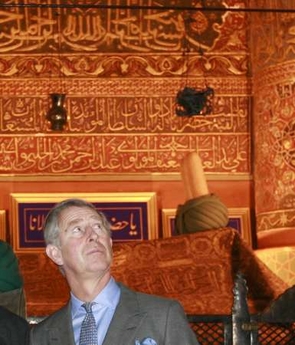
Britain’s Prince Charles visits the tomb of Mevlana Jalaluddin Rumi, founder of Sufi Islam, inside Mevlana museum in central Turkish city of Konya, November 26, 2007.
KONYA, Turkey (AP) — Prince Charles and his wife visited the mausoleum of one of Islam’s greatest mystic poets Monday and watched the traditional whirling dance of his followers, the dervishes.
The heir to the British throne and his wife Camilla, the Duchess of Cornwall, are on a four-day tour of historic sites in Turkey.
In Konya, central Turkey, they visited the mausoleum of the 13th-century poet Mavlana Jalal al-Din al-Rumi, who is considered to be the father of Sufism — the mystical form of Islam that preaches tolerance and love.

Britain’s Prince Charles and his wife Camilla, Duchess of Cornwall, visit the tomb of Mevlana Jalaluddin Rumi, founder of Sufi Islam, in Mevlana museum in the central Turkish city of Konya November 26, 2007.
The two looked at handwritten books and costumes as well as verses of the Quran painted on the ceiling.
Charles and Camilla later watched dervishes whirl in a traditional trancelike meditation, called sema, one palm turned up toward heaven, the other turned down toward earth.
In a speech after the sema ceremony, the prince said: “What better place then here near the resting place of (al-Rumi) to rededicate ourselves to the purpose of reacquiring an understanding heart and a rebalance of the East and West in ourselves.”
Sunday, February 10
What Do I Know of Love? By Rumi
What Do I Know of Love
Rumi
Rumi
I talk of Love.
He says, “what do you know of Love.”
It’s insanity, It’s Pain.
How it cuts through your soul.
How it burns.
What do I know of Love?
Explosions,
in my heart,
Then, silence.
Tears.
I have seen a glimpse of love,
And have witnessed it’s insanity.
Why do I cry? Oh God, Why…?
He speaks of your Love.
But the love of your creation alone,
has driven me,
to madness.
What do I know, of your Love?
There it goes,
Taxiing down the runway.
And here, I stand,
with my pieces all around me.
My drunken heart,
my numb senses.
What are these at my feet?
Shattered glass?
I must try to put them back together,
From where should I start?
Where should I start?
The lonely bench,
in the morning fog.
The weeping flowers.
My wailing heart.
Why do they all cry?
Why?
Do they also know,
of love?
He says, “what do you know of Love.”
It’s insanity, It’s Pain.
How it cuts through your soul.
How it burns.
What do I know of Love?
Explosions,
in my heart,
Then, silence.
Tears.
I have seen a glimpse of love,
And have witnessed it’s insanity.
Why do I cry? Oh God, Why…?
He speaks of your Love.
But the love of your creation alone,
has driven me,
to madness.
What do I know, of your Love?
There it goes,
Taxiing down the runway.
And here, I stand,
with my pieces all around me.
My drunken heart,
my numb senses.
What are these at my feet?
Shattered glass?
I must try to put them back together,
From where should I start?
Where should I start?
The lonely bench,
in the morning fog.
The weeping flowers.
My wailing heart.
Why do they all cry?
Why?
Do they also know,
of love?
Thursday, January 31
This is another lecture/sohbet from Shaikh Nazim. The Shaikh is talking about the essence of human existence. This sohbet elaborates on the importance of following the heart and going towards the positive feeling. The best part of being a Sufi is that you have a balance between the worldy life along with connection with your God. Sufism is about moderate life, being able to understand issues from both points of views and just loving life for the sake of Allah. It does not mean that you don't enjoy life, but, rather you value your afterlife more.
Hope you enjoy this. Please don't mind the translated english, I am just cut and pasting it for all of you. - Sufi
Shaykh Nazim Suhba from January 07, 2008
What you are coming for? You are here for..
It is an association. We are trying to follow the ways of the Seal of Prophets – peace be upon him. We are trying to follow the ways of followers of the sahaba, the companions of Rasulullah - sallaLlahu alayhi wa sallam. We are trying to follow good steps of awliya. Where they are putting their steps it is safe, safe step. If not, you should be in a dangerous position.
This is a world - dunya. Sometimes we are looking and seeing some preparations of armies. They're for their defense putting mines in the ground - they can't be seen or known: terrible. If you step on it, boom! Blown away! No joking from mines. It doesn't know who is stepping on it, whether a general, footsoldier, or an emperor. Therefore armies are using an expert - who knows.
Now, prophets are the first level people for knowing it is danger for mankind to be killed. Holy order from heavens is saying, "Oh My Beloved ones, look and try to protect my servants on earth, because their most dangerous enemy Shaytan is putting in such varied places so many mines, traps, or bringing hundreds of thousands of tricks to carry people to that mine."
First order from the Lord of Heavens from all Prophets and Messengers – peace be upon them – is: beware to protect my servants so they don't fall into the trap of Shaytan. Shaytan is freely going from East to West, West to East, North to South, South to North. He is not in need of carrying a passport; no need to use a visa. He is saying, "I'm free. Sometimes I am making myself clear for some of my best friends, but mostly I am camouflaging myself through people and they are thinking that I am their first-class advisor." Shaytan is free to go anywhere, even the Ka'ba, even in Prophet's Holy Masjid, and in 'Arafat as well. Everywhere free.
Like newspaper people (showing their press ID): "Today I have very important work with some VIPs. They'll be coming here and I'll be looking after them to make them even drunker. They are going to be drunk and then I will come and make a speech."
(The shaykh is mimicking a VIP giving a speech:)
"Yes, oh my servants. I was thinking that I could make a good speech for you, but I am looking not prepared and I am not remembering anything, bring me another champagne, and I may speak to those donkeys."
Everywhere Shaytan is going making an inspection. The chief inspection on mankind. For whoever is believing in heavenly knowledge and news, the inspector is Shaytan looking everywhere. Anywhere there is such a thing about heavenly knowledge or positions, he is saying, "Take that away."
Therefore, Allah Almighty is saying "Asta'idh billah". You must flee from Shaytan, you must ask protection. You must ask protection. If not, he will carry you away also. That person is looking for a station, but doesn't know where he is going. He goes but arrives at a different place than he was planning.
"Shaytan: Ya Rabbi, we are running to You from that one. Don't leave is in front of that dangerous enemy. We are weak ones."
Therefore we are saying, "A'udhu billah min ash-Shaytanir-rajim.' What was the title of our association? That all prophets are calling people to be servants of their Lord, and that is the main point for which man was created. Man must now for what he is in existence, for what reason they've been created. Then millions and millions of people are believing this, but they're not giving enough time or energy for heavenly service. People are making heavenly service, but most people are not appreciating anything for heavenly service. Never appreciating. Then so many people are accepting that they have been ordered to perform heavenly service, but they are not giving enough care for that service. They have made their main goal to reach dunya as much as possible. They are doing some heavenly service, but it's not their main target - heavenly service is our most important target. We have been created for heavenly service. Any doubt?
"Wa ma khalaqtu insi wa jinni illa li-'abudun." "I never created mankind or jinn for any purpose other than my service: 'ubudiyya - to be My divine servants. So many people are making this heavenly service, but what was the main purpose for Sahaba when they were coming into the holy circle of the Most Holy One - sallaLlahu alayhi wa sallam. What was their aim always running and listening? They knew that they'd been created for heavenly service, but they were every time coming, running to the Prophet - sallaLlahu alayhi wa sallam. Why? They were asking for more and more urging power for them for heavenly service. They were wanting to learn and know what is is the best worshipping to their Lord. They were saying, "How can we do our heavenly service in the best ways- to the best ones, that is important." Yes, you can pray five times, but five times that is not the main target. Because out of five times you are working, working. You are giving your full energy for five times. We are saying, "Enough, enough. We have so many things to do. We may pray quickly but run away." He may or not be looking at what he's saying. Our Lord is saying, "My servant is running to another service, not giving full care to my heavenly service that I was dressing them for to be an honour for them in dunya and akhira. Look, oh Angels, at my servants. Mostly they are not looking to heavenly service. Who are they considering? The servants are giving a very short time saying, "We are not in need of more than that."
Like salafi people, they are not taking care to make sunna or zawaid like what Prophet - sallaLlahu alayhi wa sallam - was doing. Only obligatory service, then they run away - go and work. When you are leaving this world that is for Allah, where are you going? Who is the foreman for manking on their service?
Foreman No.1 is Shaytan. East and West they are running and saying what is the order of the boss. "Look to see that you don't give too much time for their prayers. You must grant to them very short time for their heavenly service." They are making taslim and then taking their shoes and running away.
For whom are they running? For whose service are they running? Have I created them for My Heavenly Service, or have I created them to follow their dangerous enemy and dunya? You know, O our Lord, You know best. You created them for their Heavenly Service, but mostly they are not giving anytime for that service, or they are giving a very short time. They are taking their shoes and quickly running off. For what? For Shaytan's way. They are workers of shaytanic service. How is this dunya going to have people that are happy.
Therefore, I am happy with who is coming here. Al-Hamdulillah! You are sitting and not thinking about any other service. You are sitting, and no one is thinking about their job. No. And your main target, which is the title of the association that our grandshaykh is granting us, may Allah bless him. Say to our brothers, sisters, sons, grandsons, grand-daughters that we are doing this association to learn how we can do our service for our Lord in the best way. We are translating, and you are knowing but you cannot speak on that. Your target, how we can do our Heavenly Service in the best way. That must be through your heart always: how can I give my best service to the Lord of heavens? Therefore, we are saying, "welcome to you," as Prophets were welcoming people who were coming in such a way. Some people are coming, taking something, and running away. They were not on the same rank of Heavenly Service as other people sitting in front of the Prophet - sallaLlahu alayhi wa sallam - who were asking much more knowledge to practice their Heavenly Service in the best way. Therefore, here is a handful of people who are asking to do their best service for the Lord of Heavens. Capital for those people, but for others dangerous days are coming.
Dangerous days are coming, and I am asking forgiveness from Allah Almighty, and I am asking us to keep us on enlightened ways - not to leave us to full in dark ways. Darkness is the worst for looking at by people. May Allah forgive us. This assocation may be more than enough for the whole world to be as a sun shining on their hearts. May Allah forgive me and give much more power and authority through Muharram to take away the ways of heedlessness. That people may run from dunya to akhira. Al-Fatiha for the honour of the most honoured one in your Divinely Presence.
Hope you enjoy this. Please don't mind the translated english, I am just cut and pasting it for all of you. - Sufi
Shaykh Nazim Suhba from January 07, 2008
What you are coming for? You are here for..
It is an association. We are trying to follow the ways of the Seal of Prophets – peace be upon him. We are trying to follow the ways of followers of the sahaba, the companions of Rasulullah - sallaLlahu alayhi wa sallam. We are trying to follow good steps of awliya. Where they are putting their steps it is safe, safe step. If not, you should be in a dangerous position.
This is a world - dunya. Sometimes we are looking and seeing some preparations of armies. They're for their defense putting mines in the ground - they can't be seen or known: terrible. If you step on it, boom! Blown away! No joking from mines. It doesn't know who is stepping on it, whether a general, footsoldier, or an emperor. Therefore armies are using an expert - who knows.
Now, prophets are the first level people for knowing it is danger for mankind to be killed. Holy order from heavens is saying, "Oh My Beloved ones, look and try to protect my servants on earth, because their most dangerous enemy Shaytan is putting in such varied places so many mines, traps, or bringing hundreds of thousands of tricks to carry people to that mine."
First order from the Lord of Heavens from all Prophets and Messengers – peace be upon them – is: beware to protect my servants so they don't fall into the trap of Shaytan. Shaytan is freely going from East to West, West to East, North to South, South to North. He is not in need of carrying a passport; no need to use a visa. He is saying, "I'm free. Sometimes I am making myself clear for some of my best friends, but mostly I am camouflaging myself through people and they are thinking that I am their first-class advisor." Shaytan is free to go anywhere, even the Ka'ba, even in Prophet's Holy Masjid, and in 'Arafat as well. Everywhere free.
Like newspaper people (showing their press ID): "Today I have very important work with some VIPs. They'll be coming here and I'll be looking after them to make them even drunker. They are going to be drunk and then I will come and make a speech."
(The shaykh is mimicking a VIP giving a speech:)
"Yes, oh my servants. I was thinking that I could make a good speech for you, but I am looking not prepared and I am not remembering anything, bring me another champagne, and I may speak to those donkeys."
Everywhere Shaytan is going making an inspection. The chief inspection on mankind. For whoever is believing in heavenly knowledge and news, the inspector is Shaytan looking everywhere. Anywhere there is such a thing about heavenly knowledge or positions, he is saying, "Take that away."
Therefore, Allah Almighty is saying "Asta'idh billah". You must flee from Shaytan, you must ask protection. You must ask protection. If not, he will carry you away also. That person is looking for a station, but doesn't know where he is going. He goes but arrives at a different place than he was planning.
"Shaytan: Ya Rabbi, we are running to You from that one. Don't leave is in front of that dangerous enemy. We are weak ones."
Therefore we are saying, "A'udhu billah min ash-Shaytanir-rajim.' What was the title of our association? That all prophets are calling people to be servants of their Lord, and that is the main point for which man was created. Man must now for what he is in existence, for what reason they've been created. Then millions and millions of people are believing this, but they're not giving enough time or energy for heavenly service. People are making heavenly service, but most people are not appreciating anything for heavenly service. Never appreciating. Then so many people are accepting that they have been ordered to perform heavenly service, but they are not giving enough care for that service. They have made their main goal to reach dunya as much as possible. They are doing some heavenly service, but it's not their main target - heavenly service is our most important target. We have been created for heavenly service. Any doubt?
"Wa ma khalaqtu insi wa jinni illa li-'abudun." "I never created mankind or jinn for any purpose other than my service: 'ubudiyya - to be My divine servants. So many people are making this heavenly service, but what was the main purpose for Sahaba when they were coming into the holy circle of the Most Holy One - sallaLlahu alayhi wa sallam. What was their aim always running and listening? They knew that they'd been created for heavenly service, but they were every time coming, running to the Prophet - sallaLlahu alayhi wa sallam. Why? They were asking for more and more urging power for them for heavenly service. They were wanting to learn and know what is is the best worshipping to their Lord. They were saying, "How can we do our heavenly service in the best ways- to the best ones, that is important." Yes, you can pray five times, but five times that is not the main target. Because out of five times you are working, working. You are giving your full energy for five times. We are saying, "Enough, enough. We have so many things to do. We may pray quickly but run away." He may or not be looking at what he's saying. Our Lord is saying, "My servant is running to another service, not giving full care to my heavenly service that I was dressing them for to be an honour for them in dunya and akhira. Look, oh Angels, at my servants. Mostly they are not looking to heavenly service. Who are they considering? The servants are giving a very short time saying, "We are not in need of more than that."
Like salafi people, they are not taking care to make sunna or zawaid like what Prophet - sallaLlahu alayhi wa sallam - was doing. Only obligatory service, then they run away - go and work. When you are leaving this world that is for Allah, where are you going? Who is the foreman for manking on their service?
Foreman No.1 is Shaytan. East and West they are running and saying what is the order of the boss. "Look to see that you don't give too much time for their prayers. You must grant to them very short time for their heavenly service." They are making taslim and then taking their shoes and running away.
For whom are they running? For whose service are they running? Have I created them for My Heavenly Service, or have I created them to follow their dangerous enemy and dunya? You know, O our Lord, You know best. You created them for their Heavenly Service, but mostly they are not giving anytime for that service, or they are giving a very short time. They are taking their shoes and quickly running off. For what? For Shaytan's way. They are workers of shaytanic service. How is this dunya going to have people that are happy.
Therefore, I am happy with who is coming here. Al-Hamdulillah! You are sitting and not thinking about any other service. You are sitting, and no one is thinking about their job. No. And your main target, which is the title of the association that our grandshaykh is granting us, may Allah bless him. Say to our brothers, sisters, sons, grandsons, grand-daughters that we are doing this association to learn how we can do our service for our Lord in the best way. We are translating, and you are knowing but you cannot speak on that. Your target, how we can do our Heavenly Service in the best way. That must be through your heart always: how can I give my best service to the Lord of heavens? Therefore, we are saying, "welcome to you," as Prophets were welcoming people who were coming in such a way. Some people are coming, taking something, and running away. They were not on the same rank of Heavenly Service as other people sitting in front of the Prophet - sallaLlahu alayhi wa sallam - who were asking much more knowledge to practice their Heavenly Service in the best way. Therefore, here is a handful of people who are asking to do their best service for the Lord of Heavens. Capital for those people, but for others dangerous days are coming.
Dangerous days are coming, and I am asking forgiveness from Allah Almighty, and I am asking us to keep us on enlightened ways - not to leave us to full in dark ways. Darkness is the worst for looking at by people. May Allah forgive us. This assocation may be more than enough for the whole world to be as a sun shining on their hearts. May Allah forgive me and give much more power and authority through Muharram to take away the ways of heedlessness. That people may run from dunya to akhira. Al-Fatiha for the honour of the most honoured one in your Divinely Presence.
Friday, January 25
An Invitation to the Divine Presence
This article from Shaikh Nazim illustrates the true nature of islam, and how peaceful it is. People of Adam are all Allah (God)'s creations and Allah recognizes their good deeds better than anyone.
This article is republished from sheiknazim2.com/aninvitation.html and talks about the connection between Shaikh and his Student. There are arabic words used that are new to me as well, but the essence of the article can still be achieved.
Please contact your Shaikh for more clarification.
An Invitation to the Divine Presence
Shaikh Nazim
I ask my Lord to help me to, be Just and to uphold justice. This is what our Lord asked of mankind from the time of the first man, Adam, up to our time, and it is what will be asked of man until the Last Day. A person who stands for justice is called “Haqqani”, and that title is the essential basis of all other honourable ranks in the Divine Presence.Shaikh Nazim
“The day when truth will benefit the truthful”
It means nothing to Allah that you were known in this life as a Muslim, Christian, Jew or Buddhist, but he will be concerned with whether you deserved the title of Haqqani. Those who have been Haqqani in this life are transformed; their very essence adopts Divine attributes so that they become “Rabbani” or beings who pertain to the Lord intimately. It is about these people that Allah Almighty says in a Holy Hadith:
Oh My servant, be obedient to Me and I will make you Rabbani, Then you (also) will say to a thing “be” and so will it be. When one reaches the level of Rabbani, God dresses him in His Own attributes and makes him His deputy. Then he grants you willpower that is not your own, but His. But the way to attain the Station of Rabbani leads through the Station of Haqqani, and whoever intends sincerely to be Haqqani will receive guidance from Him.
What is the nature of the station of Rabbani? for those in that station the ocean may be as a puddle, and even the whole world may be a crumb in their hands. Abdul Wahhab ash-Shaarani, a great Sufi of Egypt, said that some men of God see the world as a candle and some see it as an atom. A man of God will first be shown the nature of the universe and all of its creatures, then he will learn about the Lord Almighty. Therefore, on his Night Journey the Holy Prophet was shown the whole universe and only thereafter was invited to leave it and enter the realm of absolute Truth. He left everything, including his self, and entered the Divine Presence, but only after he had been shown everything about the world did he enter Unity Oceans.
He entered Unity Oceans but he was ordered back to the world to invite all Nations to follow him to the Divine Presence. Those who heed his call to ascend to the seven heavens are two separate groups. The first group consists of those who may potentially attain the Station of Gabriel. When Gabriel was leading the Holy Prophet in his ascension, he stopped at a certain point, for fear of being annihilated in the Divine. That Station represents the highest attainment possible through the mind. The second group contains those who are prepared to sacrifice everything, even themselves, to attain absolute “Unity Oceans”. Their station is absolute Unity, Ahadiya, while the station of those who fail to throw off the yoke of mind, form and relativity is the station of Gabriel, the station of the awareness of Unity, Wahadiyya. The station of Wahadiyya is in Unity
Oceans, but it is a “sub-station”. It is, however, the uttermost limit for all but the fewest of seekers.
The way to the station of Ahadiyya, of absolute Unity, is one of total inner renunciation of all hopes of being something. Some of our brothers have asked me to open up to them the doors of Divine attraction, Jadhbah. It is a kind of a power, but it is not my job to dispense power, but to take it away, that you might be empty handed and thus candidates for the station of Absolute Unity.
If an unprepared person were to receive spiritual power, he would only wreak destruction upon himself and others. A little boy may admire the large horses the police ride, but if he we were to mount him on such a horse, do you think that he would be able to control it,? Sometimes a father may put his small son on his lap while he drives down a quiet street, and let him steer, but do you think that the father is really letting him drive?
Only those who have subdued their egos may be given any power. A rocket is not launched until all of its systems have been checked many times over, and the flight of each soul to its heavenly destination is much more important than launching a rocket, so don’t imagine that Grandsheikhs empower their murids (students) easily.
Once, Ubaydullah al-Ahrari called one of his murids and said: “Oh Abdullah, go climb that mountain and wait there for me, I am coming after you.” The murid climbed the mountain and began to wait. The morning passed, then the afternoon. The sun set and still there was no sign of the Sheikh. The next day the dervish waited patiently, but still the Sheikh did not come. But his orders were clear, so he waited, a week, a month, a year, five years, and seven years. He survived on that mountain as a beast would survive. In the summer he fed himself with berries and in the winter from the bark of trees. When he prayed the birds would alight on his shoulders and at night when he chanted his Dhikr the animals would gather around him in a circle.
There he waited for seven years without any news from his Grandsheikh. But the Grandsheikh had original1y received the order to send that murid to the mountain from the Holy Prophet, and he was awaiting the order to go up, after him. When the order arrived the Sheikh went up to the murid’s perch in the blink of an eye and said to him.
“Oh my son, why have you been waiting here so long? I told you that I was coming, so when I didn’t come, why didn’t you come and see what had happened to me? I could have died or been hurt; I could have been lost on the mountain, so why didn’t you search for me?" The murid answered: "Oh my Master, I was ordered to wait for you, not to look for you. You ordered me to wait here until you came, and, as the saying goes, whatever a noble person promises, that he will fulfil, so what about you, Oh most noble of mankind”! Is it possible for you to promise something and then fail to fulfil it? I would have waited here for you even until the Last Day. A dog will wait for you if you tell him to, so how shall I be less loyal and obedient? Besides, it was not too difficult for me to wait here, at least you came before I died, when you could have left me until that time too. I relied on your word, not on my mind’s judgement, as I know that you are caring for me.”
The murid had understood that his Sheikh was not really scolding him for staying there but that he was testing him by repeating the same arguments and objections that his ego had brought forward when the Sheikh had not appeared when expected. That murid attained the same level of reliance upon his Sheikh and through his Sheikh on the Prophet and ultimately on his Lord, that Abraham attained in reliance on his Lord. When Abraham was thrown in the fire by Nimrod, the Angel Gabriel came and asked him: “Are you in need of help?” I am in need of my Lord’s help, not yours,” replied Abraham. Then Gabriel said: “Then ask your Lord for help.” “There is no need for me to ask, for He sees me, looks after me and knows well, where I am and of what I am in need.’”
That murid was on exactly the same level of trust to his Sheikh. He knew that his Grandsheikh, was not a blind person, and that, therefore, he must be aware of his condition. This is why he answered his Sheikh’s queries by saying “Oh my Sheikh, I have no doubt that you are keeping me within the scope of your spiritual vision, so why should I apply my mind and will when I have given the reins of my will to you trusting that you will guide me to my Lord’s pleasure. I am in your hands like a dead body in the hands of those who wash it before burial.”
Then there appeared a flock of wild doves as an escort for a. very large green bird, a bird which appears to murids who have successfully completed their seclusion. That is a sign that the murid is ready to be escorted to the presence of the Holy Prophet and the Grandsheikhs of his assembly. The Holy Prophet ordered Ubaydullah: “Now I have witnessed that your murid is absolutely in control of his ego. you may give him his powers.
The powers received at this point are six
1) Haqiqat ul-Jadhbah (The Secret of Attraction)
2) Haqiqat ul-Fayd (The Secret of Emanation or Outpouring)
3) Haqiqat ut-Tawassul (The Secret of Connection)
4) Haqiqat ut-Tawajjuh (The Secret of Alignment)
5) Haqiqat ul-Irshad (The Secret of Guidance)
6) Haqiqat ut-Tayy (The Secret of Folding Space)
Until the Holy Prophet appears to the Grandsheikh and takes upon himself responsibility for the murid, no powers are given. But at that time the floodgates are thrown open.
In our way we must never claim to know anything or to be anything, because dissolution in Unity Oceans requires the abandonment of all pretentiousness. Most people, on the contrary spend their life energy on futile attempts to grasp something in their hands.
However, when they open their hands to see what they have, they realize that they never caught it, or even if they did, it flies away as soon as they open their hands. Even seekers of truth sometimes attempt a “catch” by trying to reach a spiritual station for the sake of their egos. In this case seekers have not completely renounced self-aggrandizement, but in accordance with their level they may attain good in this life and the next, but not that ultimate station of Ahadiyya. Only he who abandons the covetousness of this life and the next will be given pleasure that no one can imagine.
A murid becomes eligible for these powers Then he becomes free of his ego’s tyranny. When they are granted he is a free man, forever free of the limitations of time and space.
Time and space are the illusions which now bind us. When we are free they are at our command.
The Power of Attraction is the power which enabled the saintly advisor of King Solomon to bring the throne of the Queen of Sheba to Jerusalem, from Yemen in the time it takes for an eye to blink, or less (Holy Qur’an, Chapter 34). This is the power that enables one to draw anything to himself. Inanimate objects are the easiest, people the most difficult.
The Power of Emanation or Outpouring is the power to be the means for .the transfer of the experience of the Divine Presence to the murid. It is all embracing light that overflows the brim of the vessel. The Holy Prophet is the vessel in which these Divine favours are poured and, as they are without end, they flow from his heart to the hearts of Saints and from theirs to those of murids.
The Power of Connection is the power to connect at all times to this chain of transmission of Divine power and favours. For Saints it is the intimate knowledge of the Prophet’s realities and those of the chain of Sheikhs leading to him. For those who are yet aspiring to that station it is the daily invocation of the names of those Grandsheikhs leading up to the Holy Prophet. In our time, the time when the advent of Imam al-Mahdi is anticipated, many more people will have access to this power than ever before.
The Power of Alignment enables the Sheikh to turn his heart towards the hearts of his murids at any given time, and to turn their hearts towards their destinations. If he can’t do this then it is meaningless to say that he is a Sheikh. The first step is in his turning the heart of the murid towards his own, after this it will be possible to turn it onwards.
The Power of Guidance is the power to lead one on his way to his destination once he has been turned toward the direction through the Power of Alignment. For example, if you arrive at Heathrow Airport it is not enough, you must be lead or given directions to arrive at your specific destination in London. Therefore, being turned in the direction is only the first step, the door of the maze; you must be helped on through it.
The Power of Folding Space is the power to travel at will anywhere in the Universe without actually traveling the distance, but rather by “rolling it up” like a parchment. Such a thing is unattainable except for those, who have subdued the physical body absolutely.
Presently our souls are encased in our physical bodies. The secret of this power is that, by bringing the physical body under control it becomes encased in the spiritual body, and the movement of the spiritual body is not cumbersome like that of this body. What is the speed of a donkey compared to the speed of Light? The speed of light is like a donkey compared to the speed of the spiritual body.
Please don't mind the references that were translated from Arabic/Turkish to English.
Subscribe to:
Posts (Atom)